

BlogFor employers
How to read a candidate's work record in 15 minutes
A practical checklist for hiring managers: what to look at first in a graded work record, the red flags that matter, and the interview questions it hands you.
Paul E. & Paul A., Founders · Nov 2, 2026 · 3 min read

A graded work record is only useful if you know how to read it. The temptation is to look at the overall score and move on. That throws away most of what the record is for. Here is a fifteen-minute routine that gets you to a confident "yes, interview" or "no, not yet".
- Minutes 1 to 3: the shape of the record
- Minutes 4 to 8: open two cases in full
- Minutes 9 to 12: read the writing
- Minutes 13 to 15: note your interview questions
Pass 1: the shape of the record
Before any single score, look at the overall pattern:
- Which desks? Someone applying for a fraud role with only support cases is a career changer. That is fine, but it changes what you look for.
- How many graded cases? A handful is a signal. A sustained run across many shifts is a habit.
- Which parts are strong, and which are weak? Every desk is graded on several separate parts. A candidate who is strong on the call but weak on documentation will need coaching on notes, not on judgement.
Pass 2: open two cases in full
Pick one of their best-scored cases and one of their weakest. For each, open the work behind the score. On a good record, every score links to the case, the checks the candidate made and the note they wrote.
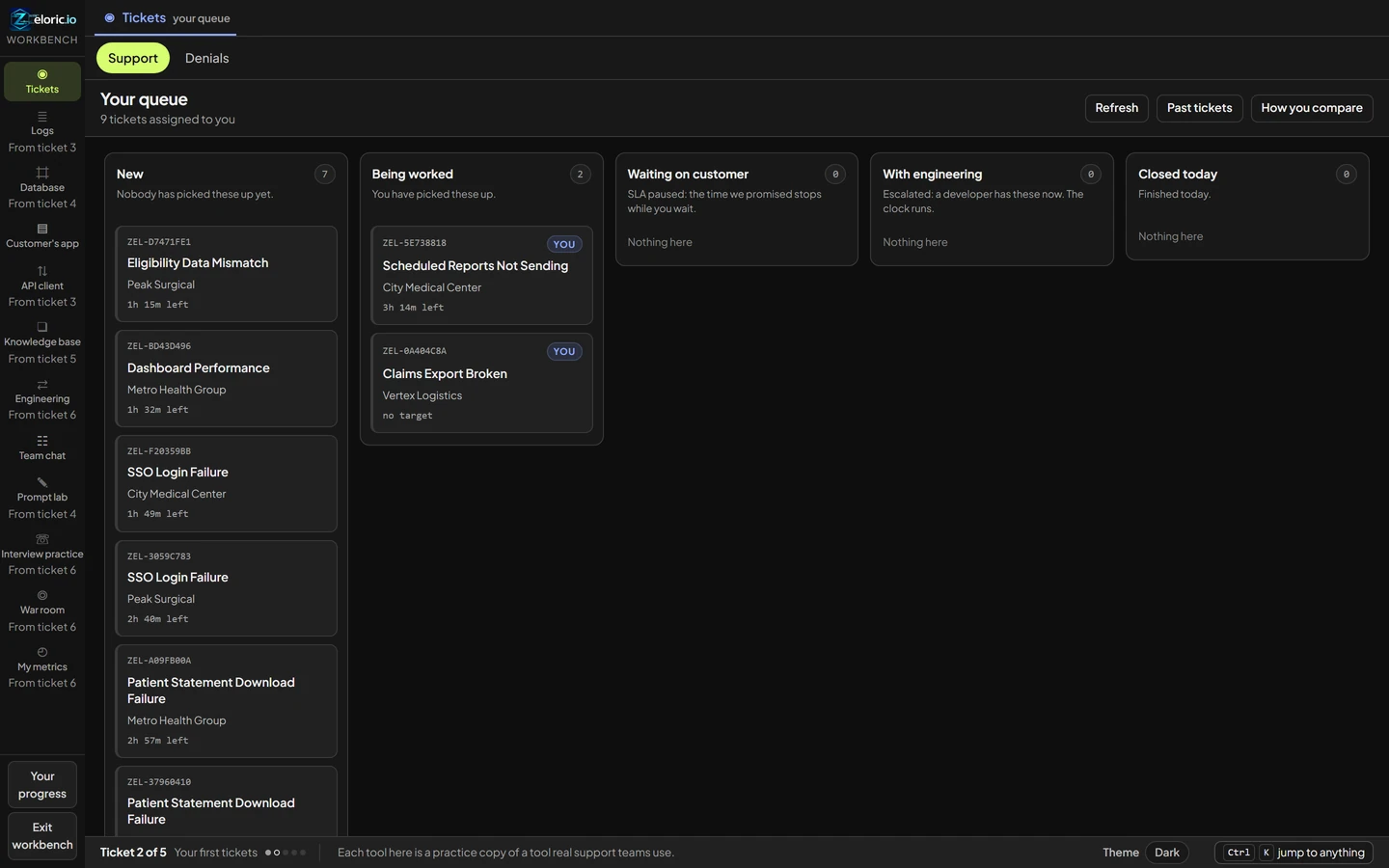
In the strong case, ask: did they get it right for the right reasons? In the weak one, ask: was it a knowledge gap, or a careless one? Knowledge gaps are cheap to fix. Carelessness under a clock tends to repeat.
Pass 3: read the writing
For every one of these roles, writing is half the job. A support reply, a fraud case note, an AML narrative and a claims appeal all have one thing in common: someone else has to act on them without asking the author.
Writing that worries you
- Restates the problem without a conclusion
- Uses "seems" and "maybe" where a fact was available
- Would make the reader ask a follow-up question
Writing that reassures you
- States the decision first
- Quotes the evidence by its values
- Leaves the reader with one clear next step
Pass 4: write your interview questions
A record does not replace the interview. It makes it much better. Instead of "tell me about a time you solved a problem", you can ask about a case you have just read:
- "On this ticket you overruled the AI's suggestion. Walk me through why."
- "Your documentation scores are lower than your diagnosis scores. What happens on your end when you write a note?"
- "This alert you escalated, and this one you closed. What was the difference?"
These questions are specific, fair, and impossible to answer from a prepared script.
A note on fairness
A structured record helps fairness in two ways. Every candidate is scored the same way on the same kind of work, and you are judging what they did rather than how they present. Keep the interview structured too: the same core questions for every candidate, scored against what the job needs.
Try it on a real one
Open the sample record and run the four passes. Then read why a work sample beats a résumé, or see how Zeloric works for teams on the employers page.
The overall score tells you whether to look. The cases behind it tell you whether to hire.
#hiring #employers #interviews
Reading about the work is one thing. Doing it is how you show it. Your first ticket is free, with no account needed.
Try a realistic ticket free